


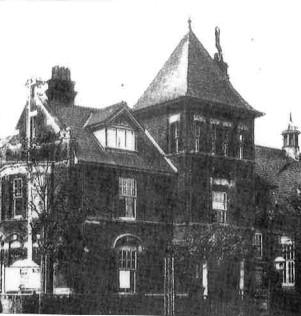
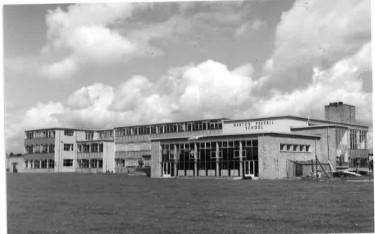

Barton Peveril Grammar School existed for only 69 years. In that space of time it experienced six name changes, occupied five distinct premises, but was led by only three head teachers. The school’s origins lay in the Pupil-Teacher Centre which was established in Eastleigh’s Railway Institute building in 1904 under the authority of the then County of Southampton. As its name suggests, this institution operated as a selective school as well as training some pupils, mostly female, for future employment in the teaching profession. In 1908, Eastleigh’s Pupil-Teacher Centre moved to the Wesleyan Church Hall.
Local history societies have recorded the memories from residents who were pupils at the Pupil-Teacher Centre. Dorothy Harrison, for example, entered on a B-Scholarship which, as a pupil-teacher, would involve two teaching practices a week in local elementary schools when she reached the qualifying age. Until then, she was taught the additional subjects of German and Science.

It was the case in Teacher-Pupil Centres nationally and locally that some pupils would enrol on the pupil-teacher route for their quality, not because they wanted to become teachers, but because they wanted to benefit from a superior high school education. Around 90 pupils numbers were enrolled in Eastleigh’s Pupil-Teacher Centre whilst it was based in the Railway Institute and Wesleyan Hall.
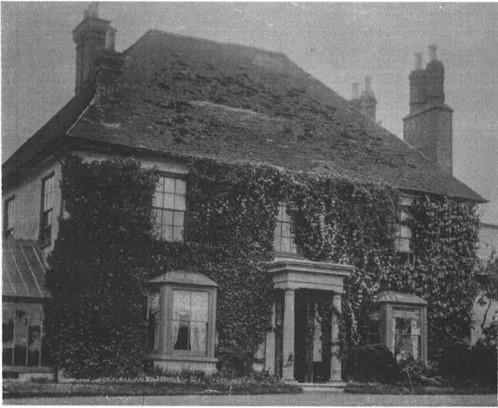
A significant move followed in 1918 with the purchase of Barton Farm House, located on the Bishopstoke Road, by the County. The the school ceased training teachers and operated solely as a high school. Its official name was Eastleigh County School, Barton Peveril. It became known colloquially by local residents as simply ‘Barton Peveril’. Past-pupil Barbara Paris described the school, sited on an island with Barton River and the leat to Barton Mill flowing around it. The school occupied the old ivy-covered redbrick farmhouse which had four white pre-fab classrooms to the rear. Biddy Cull recalled that school numbers had increased to around 200 pupils. They entered aged 11 and worked their way through five forms, leaving aged 16 with the Junior Oxford Certificate, but with the option of staying on in the sixth form to take the ‘matric’.
Biddy recounted that the surroundings of the school were a delight; “lawns running down to the river, beautiful trees, including a tulip tree which was then reputed to be the only one in Hampshire. We also had an orchard to play in and a grass tennis court …” However, by contrast, the teaching areas both in the farm house and annex were grim; inadequately heated in winter, bedevilled by leaks when it rained, and inadequately lit by gas lights when the winter afternoons grew darker.
The founder principal of the Pupil-Teacher Centre, Annie Smith, remained as school’s head mistress at Eastleigh County School. Remembering her, Biddy recalled her common sense and consideration for pupils’ welfare, and Mabel Tilbury commented on the encouragement she gave pupils. On the other hand, Bess Crumplin recalled her as being a strict Head who was very difficult to please and who patrolled the school, always wearing “a formidable look”.
The First World War had a great impact on both the School and its past pupils. Annie Smith reflected the patriotic spirit of the day in a rousing prize day speech reported in the Eastleigh Weekly News: “Our boys, if they are called upon, will be ready to leave their books and their quiet homes to join the ranks of their brothers fighting abroad, and our girls will do their part in filling the places of those called way.”
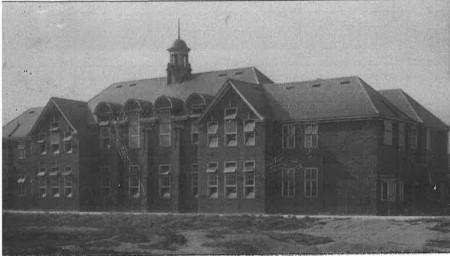
In 1932 the school moved back into Eastleigh and occupied premises in Desborough Road, with Annie Smith still in office as headmistress. Its official name was ‘Eastleigh County High School’ but for most Eastleigh inhabitants it remained known as ‘Barton Peveril’. Previously, the buildings had been home to Eastleigh County Secondary School, and after Eastleigh County High School vacated the premises in 1957 they were occupied as an annex for the Wyvern School based in Fair Oak. Following the retirement of Annie Smith, Harry Moore became the school’s new Head in 1936.
As with Annie Smith, Harry Moore served during a time of conflict with Germany. The school magazine, The Peveril, reflected aspects of a wartime education; Jean Cheater described the routines following the air raid sirens “we would dash out of the classrooms and run over to the shelters carrying our gas masks” whilst the Editor reported that “the girls of the school are still maintaining a large output of woollen comforts for the Navy. Since January 164 articles have been knitted.”
The Butler Education Act of 1944 resulted in free secondary education for all which, of course, was reflected primarily in changes to entry procedures to Eastleigh County High School. The Schools’ Correspondent of the Eastleigh Weekly News reported that the school would soon enrol 400 pupils, all of whom would be admitted, no longer in part in fees, but solely “by ability tests conducted each year by the County Education Authority for children of 11 years.”
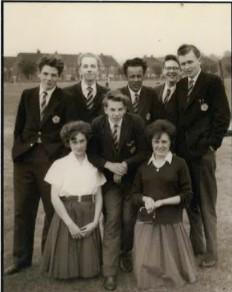
The final move came in 1957 when the school moved from Desborough Road to newly built premises in Cedar Road. There was, however, a clash of views between Headmaster Moore and the Chair of Hampshire Education Committee over the new school’s name. The Head was fastest on the draw and his preferred name ‘Barton Peveril School’ was already spelled out on a public-facing front wall of the school in large capital letters. However, it was opened by Lady Mountbatten as ‘Barton Peveril County High School’, the Chairman’s preferred school name but within 3 months, presumably the result of a compromise, it became officially known as ‘Barton Peveril Grammar School’. At the time of the move, the total number of pupils was around 600. A little over a decade later the school ceased recruiting pupils aged eleven and transitioned to towards becoming a Sixth Form College in 1973.
The formation of an alumni association was encouraged by the initial head, Annie Smith. Ex-pupils were initially referred to as ‘Peverils’ but a welcomed name change to ‘Old Bartonians’ was soon adopted. The Old Bartonians Association played an important role during the Second World War in keeping ex-pupils serving in the forces in touch with one another as well as providing social activities for those at home. Wartime and the immediate post-war years were the Old Bartonians’ heyday as an alumni association. It provided a busy social programme as well as, for some, playing the role of an informal marriage bureau. There was sufficient talent on the field to enable the Old Bartonians to have three soccer teams which competed in local leagues.
Today the Old Bartonians Association is in sharp decline since it has not been possible to attract a stream of school-leavers since 1973, meaning that it has an ever-ageing membership whose youngest current members are already approaching their early seventies. At some time in the future there will be just one surviving Old Bartonian. He, or more likely, she, will be unaware of their unique status. When this person dies, all known experiences of Barton Peveril Grammar School will die with him or her.
Dr Lynton Robins


Share